Motorcycle lean angle: what your data reveals about your riding
Lean angle is one of the most telling data points in motorcycle telemetry. Here's how to read it, interpret it, and use it to improve.
On track, lean angle is often reduced to a number riders compare: “I hit 52° at Estoril.” But behind that number lies a wealth of information about your technique, your confidence, and your margins for improvement.
What is lean angle?
Lean angle measures the offset between the motorcycle’s vertical axis and the ground’s vertical. At 0°, the bike is upright. At 50°, it’s heavily leaned in a corner.
Most loggers (AiM Solo 2, MoTeC, etc.) record this via a gyroscopic sensor or a calculation from lateral acceleration and speed.
Important: the angle displayed by your logger is the bike’s angle, not the rider’s. A rider hanging off with their torso inside the corner leans the bike less than a rider staying in line at the same corner speed.
What lean angle actually tells you
1. Your confidence in the corner
A lean angle that increases progressively session after session is the best indicator of progression. Not because leaning more is the goal, but because it reflects growing confidence in grip and trajectory.
If your max angle has been stuck at 38° for three track days, it’s probably not a tire issue — it’s a mental ceiling. And that’s normal. Telemetry lets you see it objectively.
2. Consistency corner by corner
Look at the lean angle trace across a full lap. A consistent rider shows similar angles at each pass through the same corner. An inconsistent rider varies by 5 to 10° from one lap to the next in the same corner.
This inconsistency is often invisible to feel. You think you’re doing “the same thing every lap,” but the data says otherwise. This is one of telemetry’s most valuable contributions.
3. The transition phase: lean and speed
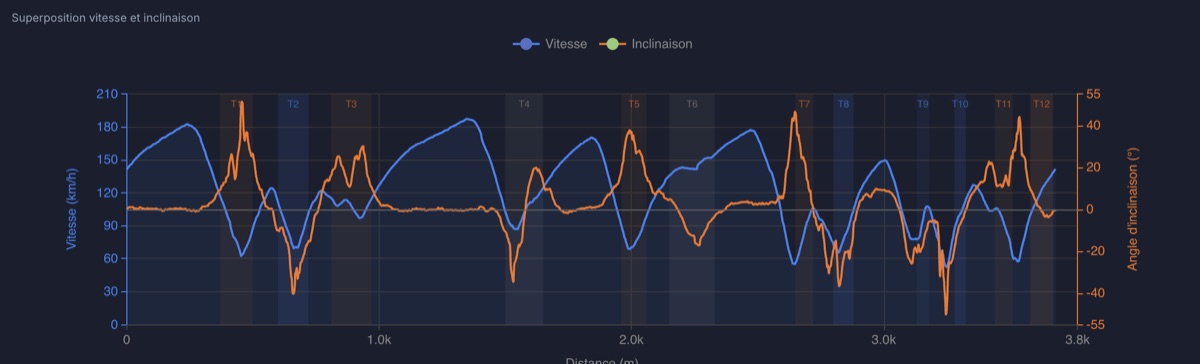
The most interesting moment isn’t the max angle — it’s the speed at which you reach that angle. Two riders can have the same 48° max lean, but the one who gets there in 0.8 seconds instead of 1.5 seconds gains time at every corner.
On Brake Point, you can overlay the lean angle trace with the speed trace to see this transition precisely. An efficient corner shows a quick, decisive tip-in, not a gradual, hesitant lean.
4. The stand-up point
Lean angle on corner exit reveals a common flaw: standing the bike up too early. If your lean trace shows a return to 0° well before full acceleration, you’re losing time. The corner isn’t over when you think it is — it’s over when the bike is upright and you’re at full throttle.
Lean angle pitfalls
Don’t compare between bikes
A supersport 600 at 45° and an adventure bike at 35° are not comparable. Wheelbase, center of gravity height, and chassis geometry completely change the relationship between lean angle and corner speed.
Don’t compare between riders (or do so carefully)
Two riders on the same bike with the same max lean don’t necessarily have the same corner speed. Body position, riding style, and trajectory change everything.
Max angle is not a goal
Chasing max lean for the number is counterproductive. The goal is corner speed. Lean angle is an indicator, not a target.
How to use lean angle on Brake Point
- Compare your laps: overlay your best lap with an average one. Look where lean differs — that’s where you’re losing time.
- Track your progression: session to session, watch whether your max angles increase on corners where you’re least comfortable.
- Cross-reference with speed: angle alone doesn’t say much. Angle combined with corner speed says everything.
- Ask BudAI: Brake Point’s AI automatically analyzes your lean angles and identifies corners where you have margin compared to your own best lap.
In summary
Lean angle is one of the most intuitive data points in motorcycle telemetry, but also one of the most misinterpreted. It’s not a numbers contest — it’s a diagnostic tool that, combined with speed and braking, shows you exactly where and how to improve.
Next time you look at your data, don’t search for your max angle. Search for the corner where your angle is most inconsistent. That’s where your next second is hiding.